👩🏾💼 RUNNING FOR WOMAN REPRESENTATIVE IN 2027? BE SEEN IN EVERY CONSTITUENCY
A Woman Representative covers the whole county. Here is how UshindiOS plans your events and shows which constituencies have not seen you yet.
By UshindiOS · · 4 min read
Platform Guides | 24 October 2026 | UshindiOS
A Woman Representative is elected by the whole county. In Kakamega that means 841,795 registered voters across 12 constituencies, 60 wards and 1,678 polling stations, the same ground as the Governor, usually with far less money. In 2022, 338,946 of those registered voters did not vote.
On a county-wide seat with a tight budget, being seen is the campaign: the baraza in Navakholo, the women's group in Mumias East, the market day in Lugari. This guide shows how UshindiOS plans that engagement and tells you every morning which constituencies have not seen you yet.
Start your woman representative campaign today: free to set up, a 14-day free trial, and nothing is charged until you decide to licence it. Start my campaign
1. The seat in numbers: Kakamega
2022 record | Kakamega |
|---|---|
Registered voters (2022) | 841,795 |
Votes cast | 502,849 (59.7% turnout) |
Registered voters who did not vote | 338,946 |
Constituencies / wards | 12 / 60 |
Polling centres / stations | 965 / 1,678 |
Source: IEBC 2022 results as held by UshindiOS. These describe 2022; they are not a forecast. Figures for your own seat are on its page under Elections.
2. What a woman representative campaign has to run
UshindiOS builds a campaign plan from the seat's real numbers: one coordinator per area, a captain for every polling centre, agents for every polling stream, the vehicles and the tally centres. For Kakamega the plan comes to:
In the plan | For Kakamega |
|---|---|
Polling agents (main, relief and tally) | 2,543 |
Mobilisers | 1,687 |
Polling centre captains | 965 |
Coordinators (county, constituency, ward) | 73 |
Field team in total | 5,353 people |
Your Campaign Manager confirms the plan in a few steps and UshindiOS applies it: the team positions are created area by area, a budget is drafted from it for you to approve, and an activity calendar is laid out. You do not start from a blank page.
3. Your morning, in thirty seconds
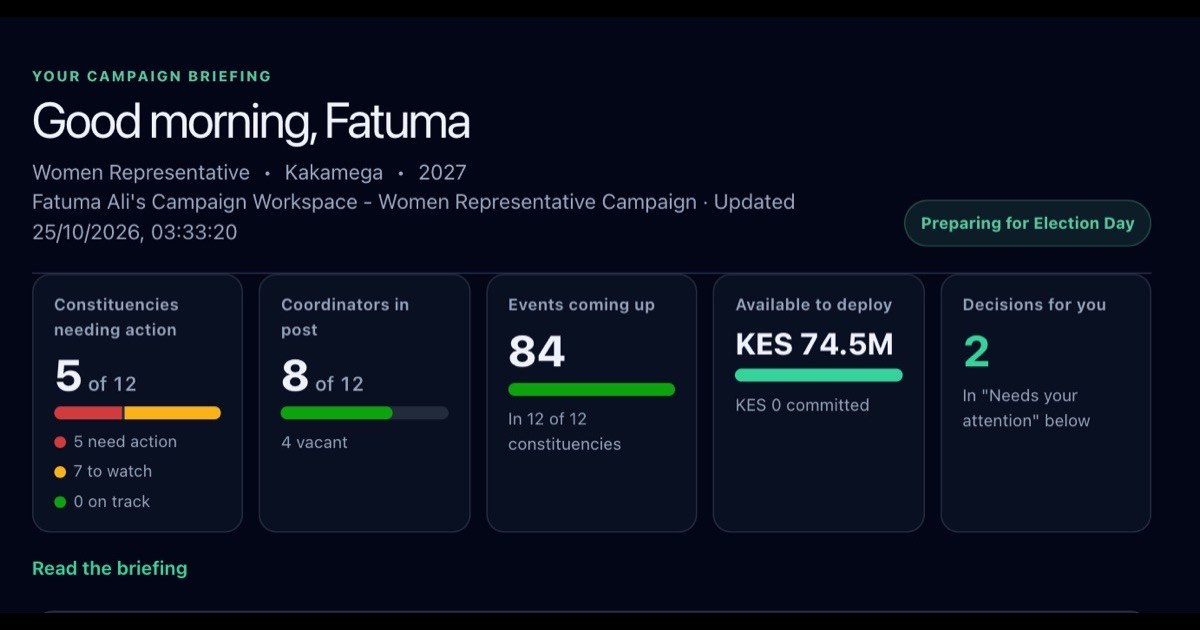
Every morning the candidate opens one page: My Campaign. It answers four questions in order: where do I stand, can I win, what changed, and what should I do next?
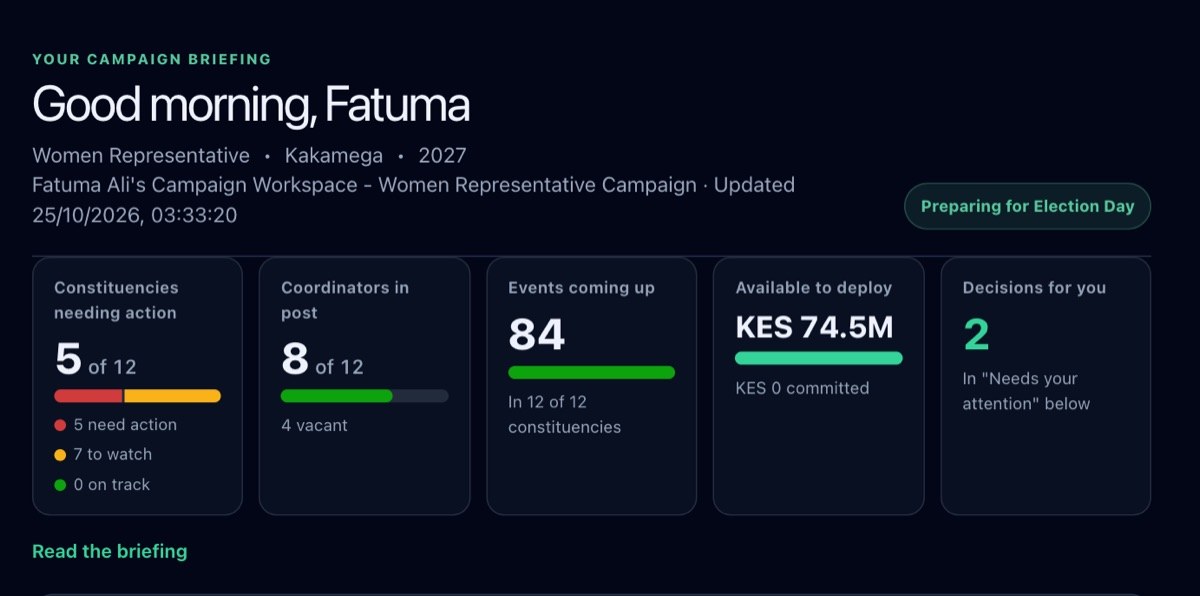
Read the briefing opens the same picture in plain sentences: how many constituencies need action and which ones, what the field team did this week, and what is waiting for you.
4. Decisions only you can make
A candidate should not be chasing paperwork, and should not be surprised by it either. When your team asks to spend money or to send resources, the request comes to Needs your attention with the amount, who raised it, the area and how long it has waited. You approve or reject it there. Missions that have run past their end date and polling stations marked not ready appear in the same place.
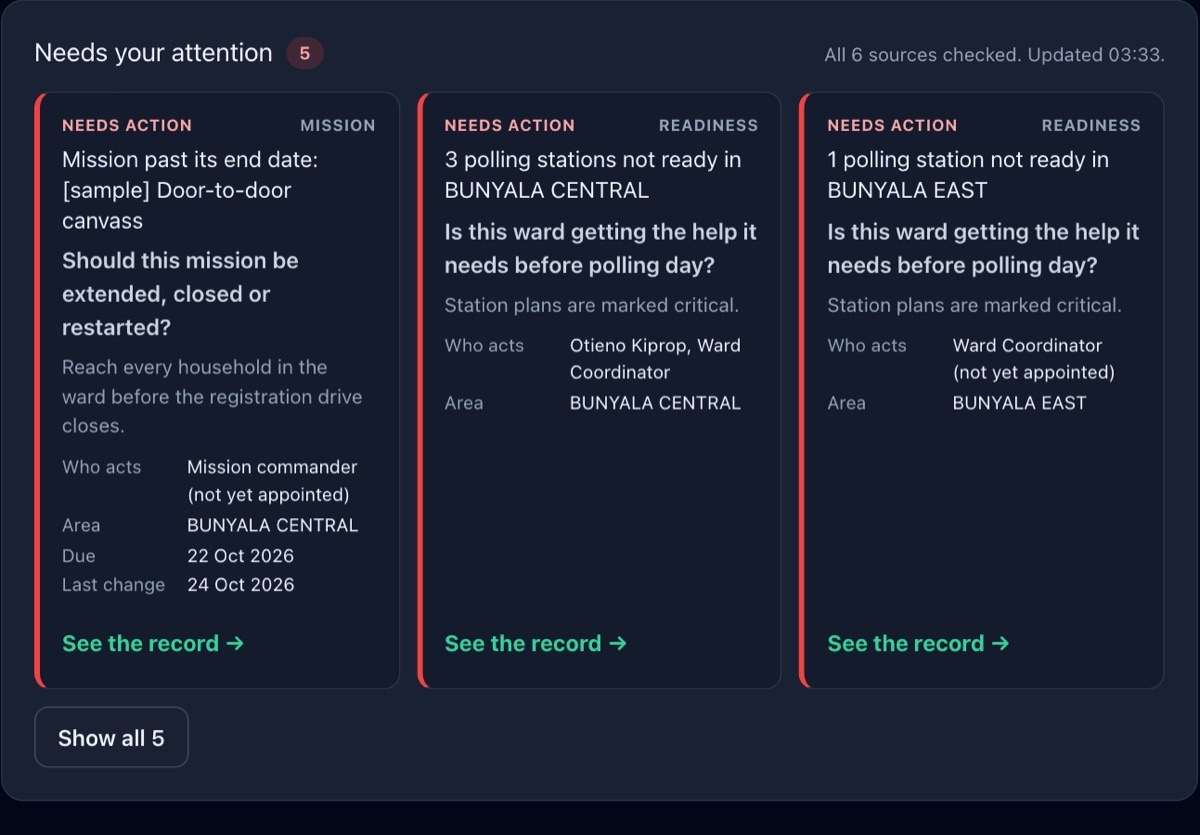
The campaign budget works the same way: your Campaign Manager prepares it, and only you approve it or send it back with what should change. Messages written in your voice are approved by you before they go out.
5. Every constituency at a glance
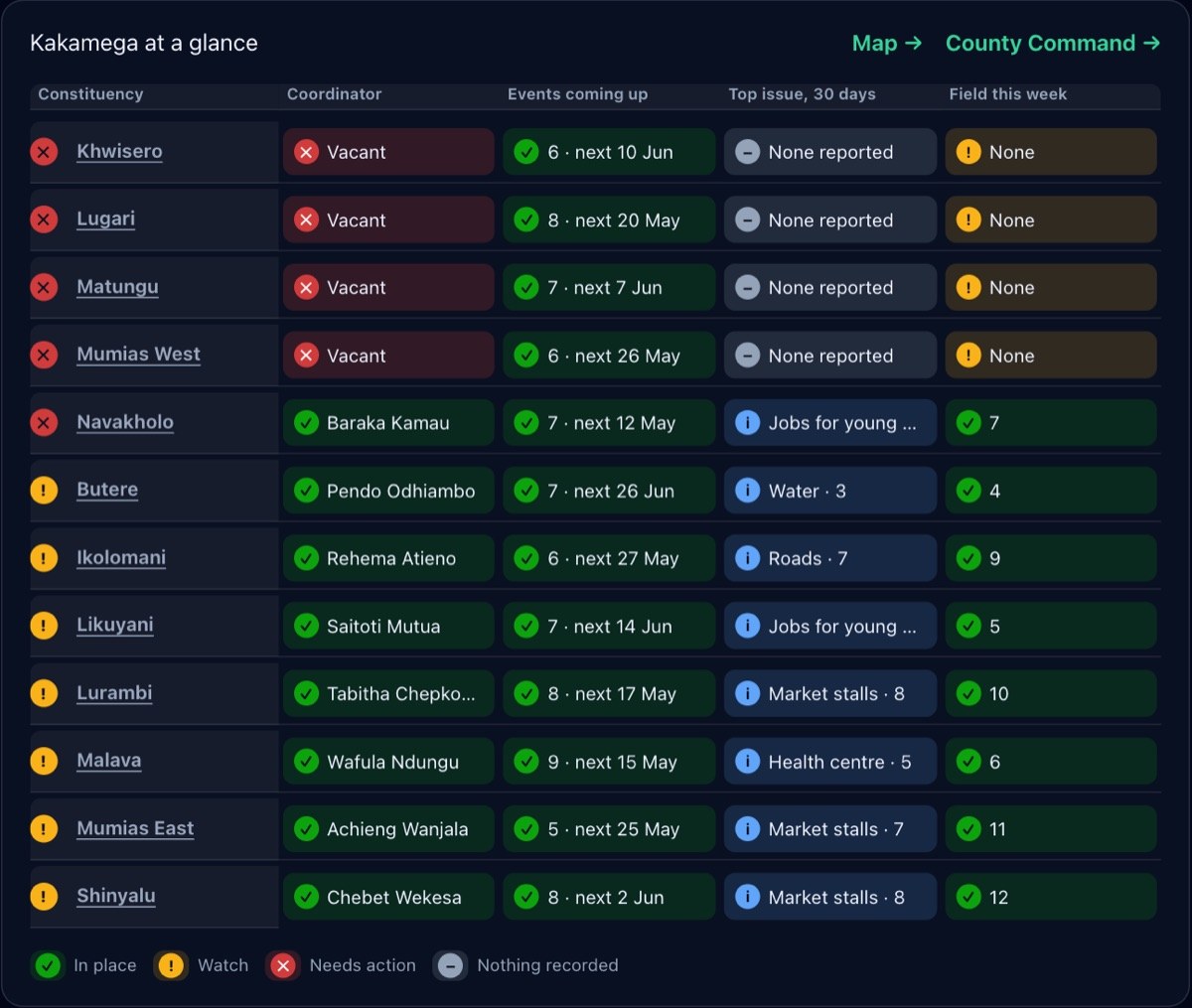
One row per constituency, one colour per state. Red needs action, with the reason (no constituency coordinator, stations not ready, a mission overdue); amber needs watching; green is in place. You see in seconds where the campaign is organised and where it is not, without calling anyone.
6. Plan where you will be seen
A Woman Representative's brief leads with engagement:
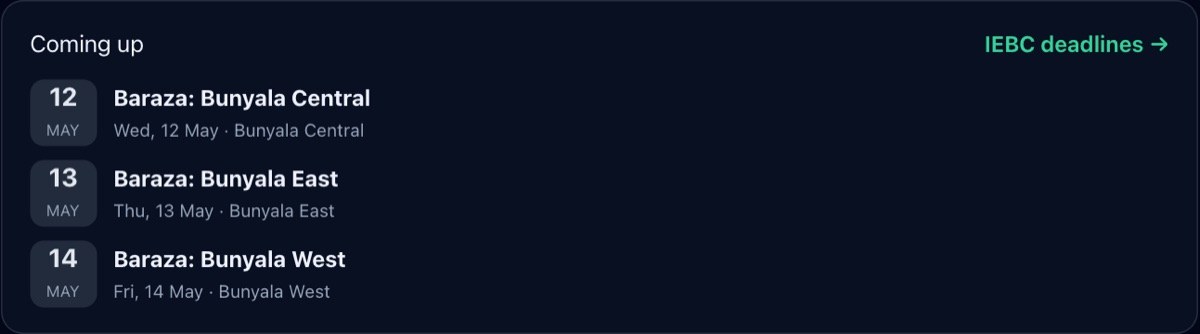
Events coming up, and in how many of the 12 constituencies. A constituency with nothing planned shows up straight away.
The calendar. When you apply your campaign plan, UshindiOS drafts the activity calendar for you, from barazas and rallies to polling-agent training, area by area. Your team then adjusts it.
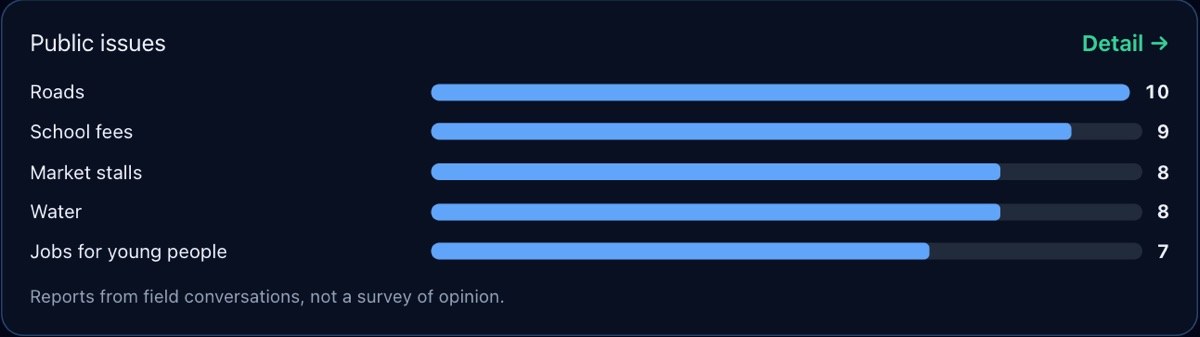
What people raise. The issues reported in field conversations, so each event speaks to what that constituency cares about.
Women candidates also pay a reduced licence. See Pricing.
7. Start your campaign
Free to set up. Create your campaign workspace, choose your seat and invite your Campaign Manager.
A 14-day free trial. Start it when you are ready. Nothing is charged until you decide to licence the platform.
One licence for the seat. Paid once for the seat you are contesting, for the whole campaign. See Pricing.
Your data stays yours. Each campaign works in its own workspace; nobody else's team sees it.
Not sure yet whether the seat is winnable? Start with the Can I Win? Report and Where Your Votes Are for your seat under Elections.
The screens in this guide come from the UshindiOS demo campaign, filled with synthetic sample data: the names, teams, requests and activity are not real. The seat figures are the IEBC 2022 results as held by UshindiOS.